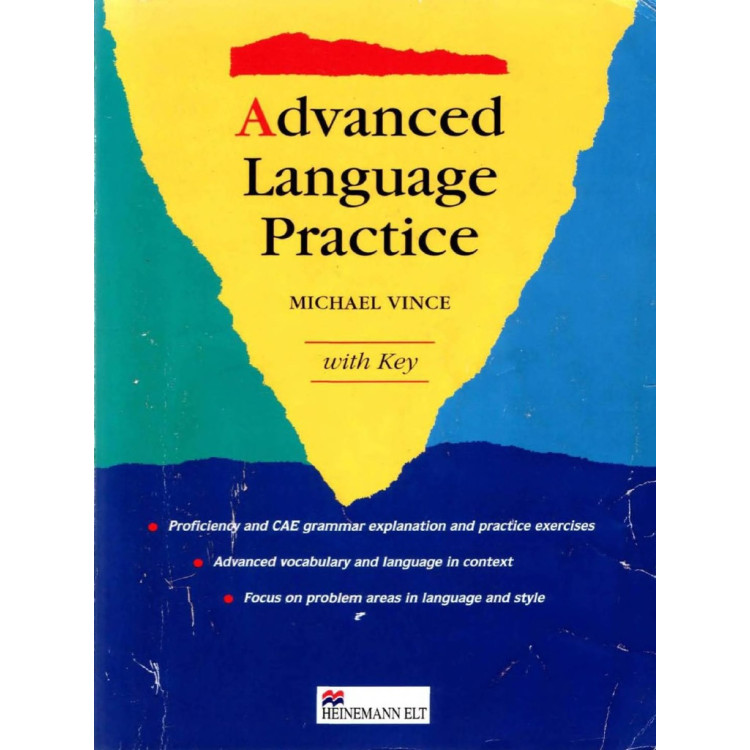
Advanced language practice Michael Vince
Сумата се прибавя директно в кошницата
7.81 €
Contents
Introduction viii
Grammar
Uniti Tense consolidation: present time l
Present simple and present continuous 1
• facts, habits, states, temporary actions, actions happening at the moment of speaking
State verbs and event (action or dynamic) verbs 1
• state verbs normally without a continuous form
• difference of meaning in stative and active Other uses of present continuous 2
• temporary or repeated actions
• complaints about bad habits
• verbs describing change and development Other uses of present simple 2
• making declarations, headlines, instructions and itineraries
• summaries of events, historic present
Unit 2 Tense consolidation: future time 7
Will, Going to, present continuous: basic contrasts 7 « will: predictive will, assumption, immediate decision
• be going to: intentions and plans, present cause
• present continuous: fixed arrangements
• speaker preference
Future continuous 7
• an event happening at a future point
• events which will happen ‘anyway’
• politeness
• fixed arrangements and plans Future perfect 8
• time which we look back at from a future point
• assumption
Other ways of referring to the future 8
• is/are to be, be about to, be on the point of, be due to
• present simple in future time clauses
• present perfect when the completion of an event is emphasised
• present simple for fixed events not simply the wishes of the speaker
Other future references 9
• hope, verbs of thinking, just, shall
Unit 3 Tense consolidation: past time 14
Past simple and past continuous 14
• past simple: completed actions, habits, states
• past continuous: temporary actions, interrupted actions, background description, changing states, repeated actions: criticism
• not used to describe habitual actions
Past perfect simple and continuous 14
• past perfect tenses: events in the past before other events in the past
• past perfect continuous: contrasts as between past simple and past continuous, indirect speech
Used to and would 15
• used to: contrast with the present, negative forms, no present time reference
• would: repeated actions not states, contrasted with used to, contexts of use
Unfulfilled past events 15
• was going to, was thinking of, was about to, was to have done
Polite forms 16
• with wonder
Contrasts with present perfect
« (see Unit 4)
Unreal time
• (see Units 8 and 9 for past tense forms used to express unreal time)
Unit 4 Tense consolidation: present perfect 20
Present perfect simple 20
• recent events without a definite time reference, indefinite events, indefinite events with an obvious result in the present, a state lasting up to the present, a habitual action in a period of time up to the present
• contrasts with past simple, speaker choice
Present perfect continuous 20
• a state lasting up to the present moment, an incomplete activity, to emphasise duration, a recently finished activity, a repeated activity
• contrasts with present perfect simple: choice of verb, completion and incompletion
Time expressions with present perfect 21
• contrast with past simple may depend on choice of time expression
• some time expressions are not associated with a particular tense
Unit 5 PROGRESS TEST 25
Unit 6 Passive 1 30
Basic uses 30
Using and not mentioning the agent 31
• change of focus, unknown agent, generalised agent obvious agent
• unimportant agent, impersonality
Unit 7 Passive 2 35
Have and get something done, need doing 35
• have something done, get something done, need doing
Passive get 35
• forming the passive with get in spoken language
Reporting verbs 35
. • present reference, past reference, past reporting verbs, passive infinitive, verbs with two objects, continuous infinitive
Verbs with prepositions 36
• ending a sentence with a preposition, by and with, be made to
• verbs followed by with, by or in.
Common contexts for the passive 37
• formality, impersonality
Unit 8 Conditionals and if- sentences 41
Basic contrasts 41
• wrhat is always true: present + present
• what was always true: past + past
• real situations: present + will
• hypothetical situations: past + would
• hypothetical past situations: past perfect + would have
• with modals
• if only
• unless, and other alternatives to if: as long as, so long as, provided
• only if, even if
• past events with results in the present
• colloquial past situations
Other tenses in conditional sentences 42
• go mg to
• present perfect
• doubt and uncertainty t should
• were to
• happen to
• if it were not for, if it hadn't been for
• will and would: politeness and emphasis
Other ways of making a conditional sentence 43
• supposing, otherwise
• but for
• if so, if not
• colloquial omission of if
• if and adjectives
• if meaning although
Unit 9 Unreal tenses and subjunctives 48
IPs time 48
• it's time, it's high time, was and were
Wishes 48
• present, would and could, past, wish and hope
Fd rather 49
• I’d rather and I’d sooner, I'd prefer
As if, as though 49
• real and unreal, present and past
Suppose and imagine 49
• understood conditions, present or past
Formal subjunctives 50
• insist, demand, suggest, require
• it is necessary, essential, important
• less formal usage with should, past tense, or infinitive
Formulaic subjunctive 50
• God Save the Queen, be that as it may, come what may
Unit 10 PROGRESS TEST 54
Unit 11 Modal auxiliaries 1: present/future 59
Don’t have to and must not 59
® absence of obligation, obligation not to do something
Should 59
• expectation, recommendation, criticism of an action, uncertainty
• with verbs ot trunking, with he and adjectives describing chance
« after in case to emphasise unlikelihood
Could 59
• possiblity or uncertainty, with comparative adjectives to express possibility or impossibility, suggestions, unwillingness
Can 60
• criticism, capability
Must and can’t 60
• certainty, present time reference only
May and might 60
• although clauses, may/might as well, possibility or uncertainty
• with try
Shall 60
• certainty, what the speaker wants to happen
Will 61
• assumption, intention, refuse and insist
Would 61
• annoying habits, certainty, with adjectives to express a tentative action
Need 61
• need to not a modal, need partly a modal
Related пол-modal expressions 61
• had better, be bound to
Unit 12 Modal auxiliaries 2: past 65
Had to and must have 65
• past obligation, past certainty
Should have and ought to have 65
• expectation, criticism of an action, should have and verbs of thinking
• with be and adjectives describing chance, polite expressions
Could have 65 .
• past possibility or uncertainty, with comparative adjectives,
• unwillingness
Could 66
• past permission or ability, compared with could have
May have and might have 66
• past possibility, uncertainty, annoyance, irony
Must have and can’t have 66
• certainty, with surely
Would not 66
• unwillingness
Would have 66
• events in the past wfiich did not happen, assumptions
Needn 4 have and didn 4 need to 66
• unnecessary actions done and not done
Adverbs and modals 67
• well, easily, obviously, really, just
Unit 13 Inversion 71
Inversion 71
• using a question form of the main verb, changing the normal position of verb and subject
Inversion after negative adverbials 71
• context of use: never, rarely, seldom;
hardly, barely, scarcely, no sooner, phrases containing no/not, little
Inversion after so that, such that 72
• context of use, so, such, inversion rules
Inverted conditional sentences without if 72
• sentences beginning Were..., Should..., Had...,
• inversion after as, formal uses
• inversion after so, neither, nor,echoing statements
Unit 14 Emphasis 77
Changing word order to change focus 77
• passive, fronting and inversion, may clauses, cleft and pseudo cleft sentences beginning It..., or with what clauses, or with all
Adding words for emphasis 78
• own, very and indeed, negatives, the, question words ending -ever
• auxiliary do, adverbs and adjectives, echoing phrases with so
Other means 79
• time phrases, repetition of main verb, starting a sentence with a possessive pronoun
Unit 15 PROGRESS TEST 84
Unit 16 Indirect speech and reporting 89
Problems 89
• indirect speech with modals, with conditional», don't think, past tenses
Reporting verbs 90
• followed by that + clause, followed by person +to, followed by subjunctive or should, other types, that + clause containing would
» verbs used impersonally with it
Functions 91
• verbs that describe a function, verbs that describe actions
Changes of viewpoint :this and that 91
• time, place, person
Unit 17 Articles 95
Definite article 95
• classes, national groups, other groups, unique objects, titles
• other titles, musical instruments, emphatic use, geographical names
® place names, most and the most, importance of context
Indefinite article 97
• jobs, measuring, unknown people
Zero article 97
• names, unique organisations, streets
Translation problems 97
• problems with use of the article
Unit 18 Relative/non-finite clauses 101
Defining and non-defining 101
• defining, non-defining
Which and that 101
• which in defining clauses, which in non-defining clauses, which after prepositions, that instead of who
Who and whom 101
• formal use of whom, whom after prepositions
Whose 102
• of whom
When and where 102
• non-defining, defining
Omitting the relative 102
• in defining object clauses, sentences ending in a preposition or phrasal verb in defining clauses
Omitting which/who + be 102
• the only one, the first one, the last one Words referring to a previous clause 102
• which, at which time/point, in which case, by which time, in which event
Clauses beginning with what and whatever 102
• meaning the thing or things which
• whatever, whichever, whoever
Non-finite clauses containing an -ing form 103
• actions happening at the same time
• actions happening one after the other
• an event which is the result of another event
• shortening passive constructions
Unit 19 Verbs followed by -ingor infinitive 107 Verbs followed by either -ing or infinitive with to 107
• can’t bear, hate, like, love, prefer,attempt, begin, continue, intend etc,
• forget and remember, try, go on, mean, regret
• stop, hear, see and watch
Verbs with an object, followed by either -ing or infinitive with to 108
• admit, allow, etc, consider, imagine, require
Verbs normally followed by infinitive with to 109
• agree, etc
Verbs normally followed by -ing 109
• appreciate, etc
Verbs followed by infinitive without to 110
• help, make, let
Verbs followed by an object and to 110
• advise, etc
• dare
Unit 23 Phrasal verbs 1 130 Voc
Add up to get up to 1 Li I
Unit 24 Phrasal verbs 2 136 ■ 2 T: j
Give away to put up with 3 N I 4 P
Unit 25 Phrasal verbs 3 142 5 IV 6 T j-
Rip off to work out
Unit 26 PROGRESS TEST 147 7 E |
Unit 27 Text features 1 152 ; 8 Е 1
Reference words 152 9 Г
• this, that, it 10 si
• such
Text organisers 152 11 i I
• adding a point ■ ■ 12. < j
• contrast 13 1 j
• logical relations
Collocations 153 14 1
Problems with plurals 153
• news, means, adjectival phrases 15 ' | 16 • {
Unit 28 Text features 2 157 17 ■ i
Organisers 157
• following points, related phrases 18 !
Modifying words and phrases 157 • intensifying a point, giving an opinion,
modifying an opinion, making assertions, giving 19 |
examples, linking cause and effect, summarising, that
meaning ‘the one’ 20 (.
Words commonly mis-spelled 162
• problem words, US English and GB English spelling
• words with similar spelling but different meanings
• words with the same pronunciation butdifferent spelling and meaning
Punctuation 163
• apostrophes
• colons and semi-colons
Unit 29 Text features 3 162
Unit 30 PROGRESS TEST 168
Unit 20 PROGRESS TEST 114
Unit 21 Verbs followed by prepositions 119
Verbs followed by: in, for, of with, from, on, against, about, out, at, to
Unit 22 Prepositions following adjectives, and in prepositional phrases 125
Following adjectives: of, about, with, at, on, to, by, for, in, from 125
Following nouns: on, to, over, with, for 125 Expressions beginning: in, with, at, on, beyond, by, for, out of, under, without, within, after 12
Vocabulary
1 Leisure Activities 173
2 Travel and Movement 176
3 News Events 179
4 Places 183
5 Media and Advertising 186
6 The Natural World 189
7 Education and Work 192
8 Business and Money 196
9 People and Relationships 199
10 Social Problems 203
11 Arts and Entertainment 206
12 Government and Society 209
13 Health and the Body 213
14 World Issues 216
15 Thinking and Feeling 220
16 Technology 224
17 Quality and Quantity 227
18 Word Formation 1 230
• words with more than one meaning, word formation, prefixes, adverbs, suffixes, compound words
19 Word Formation 2 232
• suffixes, word formation, suffixes, compound words
20 Word Formation 3 235
• words easily confused, word formation, suffixes,