Epidemiology infection diseasse parasitology and tropical diseasse medical students 6 course
Сумата се прибавя директно в кошницата
7.58 €
Етикети: Epidemiology infection diseasse parasitology and tropical diseasse medical students 6 course
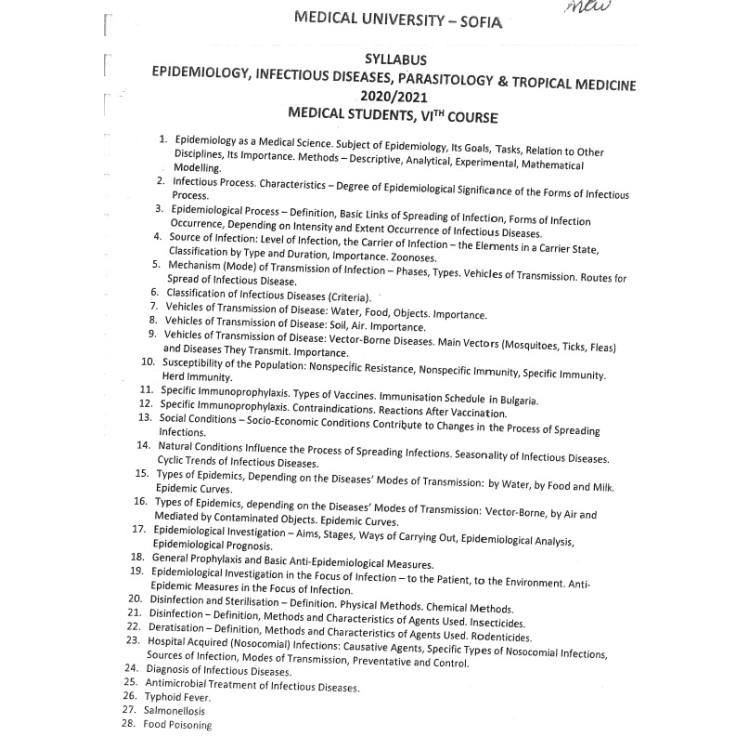
MEDICAL UNIVERSITY-SOFIA
SYLLABUS
EPIDEMIOLOGY, INFECTIOUS DISEASES, PARASITOLOGY & TROPICAL MEDICINE
2020/2021
MEDICAL STUDENTS, VIth COURSE
1. Epidemiology as a Medical Science. Subject of Epidemiology, Its Goals, Tasks, Relation to Other Disciplines, Its Importance. Methods - Descriptive, Analytical, Experimental, Mathematical
. Modelling.
2. Infectious Process. Characteristics - Degree of Epidemiological Significance of the Forms of Infectious Process.
3. Epidemiological Process - Definition, Basic Links of Spreading of Infection, Forms of Infection Occurrence, Depending on Intensity and Extent Occurrence of Infectious Diseases.
4. Source of Infection: Level of Infection, the Carrier of infection - the Elements in a Carrier State, Classification by Type and Duration, Importance. Zoonoses.
5. Mechanism (Mode) of Transmission of Infection - Phases, Types. Vehicles of Transmission. Routes for Spread of Infectious Disease.
6. Classification of Infectious Diseases (Criteria).
7. Vehicles of Transmission of Disease: Water, Food, Objects, importance.
8. Vehicles of Transmission of Disease: Soil, Air. Importance.
9. Vehicles of Transmission of Disease: Vector-Borne Diseases. Main Vectors (Mosquitoes, Ticks, Fleas) and Diseases They Transmit. Importance.
10. Susceptibility of the Population: Nonspecific Resistance, Nonspecific Immunity, Specific Immunity.
Herd Immunity.
11. Specific Immunoprophylaxis. Types of Vaccines. Immunisation Schedule in Bulgaria.
12. Specific Immunoprophylaxis. Contraindications. Reactions After Vaccination.
13. Social Conditions - Socio-Economic Conditions Contribute to Changes in the Process of Spreading Infections.
14. Natural Conditions Influence the Process of Spreading Infections. Seasonality of Infectious Diseases. Cyclic Trends of Infectious Diseases.
15. Types of Epidemics, Depending on the Diseases' Modes of Transmission: by Water, by Food and Milk. Epidemic Curves.
16. Types of Epidemics, depending on the Diseases' Modes of Transmission: Vector-Borne, by Air and Mediated by Contaminated Objects. Epidemic Curves.
17. Epidemiological Investigation - Aims, Stages, Ways of Carrying Out, Epidemiological Analysis, Epidemiological Prognosis.
18. General Prophylaxis and Basic Anti-Epidemiological Measures.
19. Epidemiological Investigation in the Focus of Infection - to the Patient, to the Environment. Anti-Epidemic Measures in the Focus of Infection.
20. Disinfection and Sterilisation - Definition. Physical Methods. Chemical Methods.
21. Disinfection - Definition, Methods and Characteristics of Agents Used. Insecticides.
22. Deratisation - Definition, Methods and Characteristics of Agents Used. Rodenticides.
23. Hospital Acquired (Nosocomial) Infections: Causative Agents, Specific Types of Nosocomial Infections, Sources of Infection, Modes of Transmission, Preventative and Control.
24. Diagnosis of Infectious Diseases.
25. Antimicrobial Treatment of Infectious Diseases.
26. Typhoid Fever.
27. Salmonellosis
28. Food Poisoning