
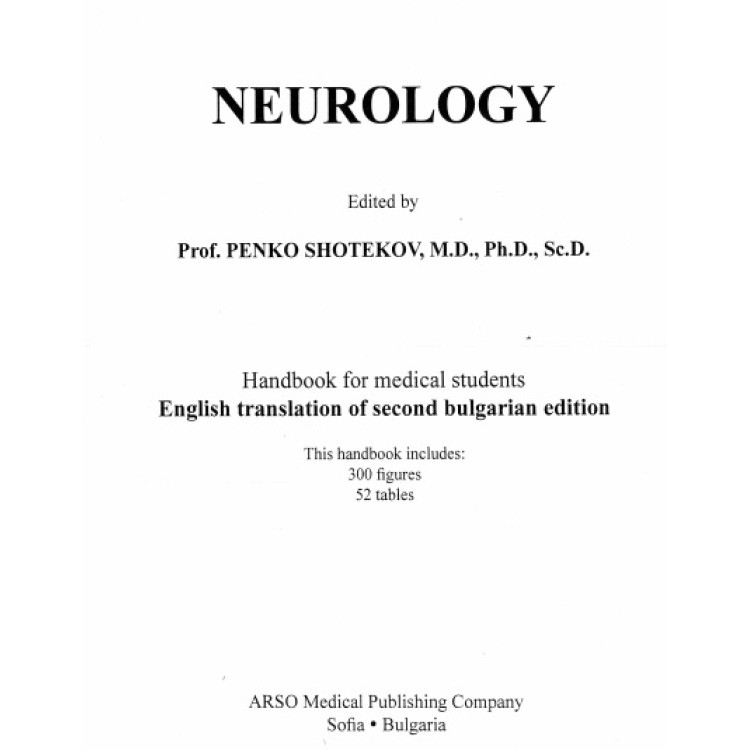
Neurology, Shotekov, Handbook for medical students
Сумата се прибавя директно в кошницата
13.99 €
.
CONTENTS
Contributors HI
Foreword V
Abbrevations VII
GENERAL NEUROLOGY 1
1. REFLEXES - N. Deleva 1
1.1. General Part Anatomy & Physiology 1
1.2. Classification 2
1.3. Normal segmental reflexes. Examination and pathologic deviations 2
1.3.1. Anatomic and physiologic data 2
1.3.2. Requirements to elicit normal reflexes 3
1.3.3. Normal segmental reflexes 3
1.3.4. Inter-segmental reflexes 3
1.3.5. Supraspinal reflexes 3
1.3.6. Pathological changes of normal reflexes 5
1.4. Pathologic reflexes 6
1.4.1. Pathologic reflexes of Babinski and Rossolimo groups 6
1.4.2. Reflexes of oral automatism (axial reflexes) 7
1.5. Reflexes of spinal and brainstem automatism. Grasping reflex 7
1.5.1. Reflexes of spinal automatism (defensive reflexes) 7
1.5.2. Reflexes of brainstem automatism « 7
1.5.3. Grasping reflex of Yanishevski * 8
2. SENSATION - P. Shotekov 9
2.1. Anatomy & Physiology of Sensation 9
2.1.1. Receptors and types of sensation 9
2.1.2. Superficial sensation 11
2.1.3. Deep sensation 15
2.1.4. Autonomic sensation 16
2.2. Sensory Symptoms 16
2.3. Assessment of general sensation 18
2.4. Sensory Syndromes 19
2.4.1. Sensory syndromes in peripheral nerve lesions 19
2.4.2. Sensory syndromes in dorsal root damage 20
2.4.3. Sensory disorders in spinal ganglia damage 20
2.4.4. Sensory syndrome of spinal cord dorsal horn lesion 20
2.4.5. Syndrome of complete spinal cord lesion 20
2.4.6. Sensory syndrome of incomplete ini lateral spinal cord lesion 21
(Brown-Sequard syndrome)
2.4.7. Syndrome of spinothalamic pathway damage 21
2.4.8. Posterior column syndrome 21
2.4.9. Brainstem syndromes 22
2.4.10. Thalamic sensory syndromes (Dejerine-Roussy Syndrome) 22
2.4.11. Sensory cortical syndromes 22
2.4.12. Psychogenic sensory disorders 22
3. MOTOR ACTIVITY - Iv. Milanov, D. Georgiev 25
3.1. Pyramidal system. Central (upper) and peripheral (lower) motor neuron 25
Anatomy & Physiology - Iv. Milanov
3.2. The extrapyramidal system. Anatomy & Physiology - Iv. Milanov 27
3.3. Muscle tone. Anatomy & Physiology - Iv. Milanov 30
3.4. Examination of motor activity and its disorders - Iv. Milanov 31
3.4.1. Muscular strength examination 31
3.4.2. Muscle tone examination 32
3.5. Disorders of muscle tone - Iv. Milanov 32
3.6. Syndrome of central and peripheral motor neuron - Iv. Milanov 34
3.7. Extrapyramidal syndrome- D. Georgiev 35
3.7.1. Hypokinetic disorders 35
3.7.2. Hyperkinetic disorders 36
4. COORDINATION OF MOVEMENTS - P. Shotekov 38
4.1. Cerebellum. Anatomy & Physiology 38
4.2. Cerebellar symptoms and syndromes; Examination 45
4.2.1. Vermis (vestibulo-spinocerebellar) syndrome 45
4.2.2. Spinocerebellum intermediary syndrome 45
4.2.3. Neocerebellar (cerebrocerebellar) syndrome 46
4.3. Coordination syndromes 47
5. GAIT, SYNKINESIA, SPEECH AND THEIR DISORDERS - P. Shotekov 49
5.1. Gait and postural disorders 49
5.2. Speech disorders caused by disrupted articulation and phonation 51
6. CRANIAL NERVES. ANATOMY & PHYSIOLOGY. EXAMINATION AND DISORDER
SYNDROMES - P. Shotekov, S. Cherninkova 52
6.1. N. Olfactorius (Olfactory Nerve), CNI - P. Shotekov 53
6.2. N. Opticus (Optic Nerve), CN II - S. Cherninkova 54
6.2.1. Visual perception. Anatomy & Physiology „ 54
6.2.2 Examination of vision and syndromes of abnormality 55
6.3. OCULOMOTOR CRANIAL NERVES: N. Oculomotorius (Oculomotor Nerve),
CN HI, N. Trochlearis (Throchlear Nerve), CN IV, N. Abducens (Abducens Nerve),
CN VI - S. Cherninkova 57
6.3.1. Anatomy & Physiology 57
6.3.2. Supranuclear and intemuclear oculomotor lesions 59
6.3.3. Autonomic innervation of the intrinsic eye muscles л60
6.3.4. Examination of the oculomotor nerves. Symptoms of oculomotor nerve damage 62
6.3.5. N. Oculomotorius. Abnormality syndromes 64
6.3.6. N. Trochlearis. Abnormality syndromes 64
6.3.7. N. Abducens. Impairment syndromes 64
6.4. N. Trigeminus (Trigeminal nerve), CN V - P. Shotekov 65
6.5. N Facialis (Facial nerve), CN VII - P. Shotekov 66
6.6. Taste sensation - P. Shotekov 69
6.7. N. Vestibulocochlearis/N. Statoacusticus (Vestibulocochler nerve), CN VUIP. Shotekov 69
6.7.1. Auditory system 69
6.7.2. Vestibular system 72
6.8. N. Glossopharyngeus (Glossopharyngeal Nerve), CN IX N - P. Shotekov 76
6.9. N. Vagus (Vagus nerve), CN X - P. Shotekov 76
6.10. N. Accessorius (Accessory nerve), CN XI -P. Shotekov 77
6.11. N. hypoglossus (Hypoglossal nerve), CN XIIN - P. Shotekov 78
6.12. Bulbar and pseudobulbar palsy - P. Shotekov 78
7. HIGHER CORTICAL FUNCTIONS AND THEIR DISORDERS. FUNCTIONAL
ASYMMETRY OF CEREBRAL HEMISPHERES - M. Rasheva, Iv. Tarnev 80
7.1. Gnosis and agnosias - M. Rasheva 81
7.1.1. Visual agnosias 81
7.1.2. Auditory agnosias 81
7.1.3. Tactile agnosia (stereoagnosia) 81
7.1.4. Spatial disorders 81
7.2. Praxis and apraxia - M. Rasheva 82
7.3. Disorders of linguistic (verbal) functions. Aphasias - Iv. Tarnev 83
7.3.1. Motor aphasias 85
7.3.2 Sensory aphasia 86
7.3.3. Mixed and global aphasia 87
7.3.4. Writing and reading disorders. Alexia and agraphia 87
4.3.5. Examination of aphasic patients 89
8. SLEEP AND WAKEFULNESS DISORDERS - M. Milanova 90
8.1. Normal sleep and sleep architecture 90
8.2. Insomnias 91
8.3. Hypersomnias, not associated with breathing abnormalities 93
8.4. Hypersomnia with breathing abnormalities 94
8.5. Parasomnias 95
8.6. Circadian disorders 95
8.7. Sleep-related motor disorders 96
9. CONSCIOUSNESS AND RELATED DISORDERS. BRAIN DEATH - П. Стаменова 97
9.1. Qualitative impairments of consciousness. Acute psychomotor agitation syndrome 97
9.2. Quantitative impairments of consciousness 97
9.3. Brain death 99
10. AUTONOMIC (VEGETATIVE) NERVOUS SYSTEM - P. Shotekov 100
10.1. Peripheral autonomic nervous system 100
10.1.1. Autonomic sensation. Visceral pain 7 100
10.1.2. Sympathetic nervous system 101
10.1.3. Parasympathetic nervous system 103
10.1.4. Enteral nervous system 106
10.1.5. Functional characteristics of the sympathetic and parasympathetic system 106
10.1.6. Clinical examination of the autonomic nervous system 106
10.2. Neurovegetative syndromes 107
10.2.1. Paroxysmal disorders of the autonomic nervous system 107
10.2.2. Topographic vegetative syndromes 108
10.3. Autonomic innervation of the pelvic reservoirs. Bladder and bowel
dysfunction 108
10.3.1. Bladder innervation 108
10.3.2. Central and peripheral bladder syndromes 109
10.3.3. Rectum innervation and neurological lesion syndromes 110
10.3.4. Autonomic innervation of the genital organs. Neurological disorders 110
10.4. Central autonomic structures. Hypothalamus and hypothalamic syndromes Ill
11. LIMBIC SYSTEM LIMBIC SYNDROMES AND DISORDERS - P. Shotekov 115
11.1. Functional aspects of the limbic system 116
11.2. Limbic syndromes and disorders 117
12. CEREBROSPINAL FLUID SYSTEM AND BLOOD BRAIN BARRIER - E. Zvetanova 118
12.1. Anatomy & physiology of CSF system 118
12.2. Sampling CSF 119
12.3. CSF examination 120
12.4. Biochemical and immunologic examination 122
12.5. CSF syndromes 124
13. SPECIFIC INSTRUMENTAL EXAMINATIONS OF THE NERVOUS SYSTEM -
M. Radionova, Iv. MiSanov, P. Shotekov, Iv. Dimitrov 125
13.1. Electroencephalography - M. Radionova 125
13.1.1. Clinical significance of electroencephalography 128
13.1.2. Video EEG monitoring 129
13.1.3. EEG mapping (Brain mapping) 129
13.2. Evoked potentials - M. Radionova 131
13.3. Electromyography - Iv. Milanov 132
13.3.1. Electromyographic and electroneurographic changes due to damage
of the peripheral motor neuron 133
13.4. Ultrasonographic examinations - P. Shotekov 134
13.5. Neuroradiological examinations - Iv. Dimitrov 135
13.5.1. Native skull and spinal column images (conventional radiography) 135
13.5.2. Brain angiography 135
13.5.3. Myelography 135
13.5.4. Computer tomography 136
13.5.5. Magnetic resonance imaging 137
13.5.6. Positron emission tomography (PET) 139
13.5.7. Single photon emission computed tomography (SPECT) 139
14. TOPICAL DIAGNOSIS AND NERVOUS SYSTEM SYNDROMES - P. Shotekov 153
14.1. Cortical syndromes 153
14.1.1. Frontal lobe syndrome 153
14.1.2. Parietal lobe syndrome 155
14.1.3. Temporal lobe syndrome 155
14.1.4. Occipital lobe syndrome 156
14.2. Syndrome of the capsula interna .* 157
14.3. Thalamic syndromes 157
14.4. Brainstem syndromes 158
14.4.1. Mesencephalon syndromes 158
14.4.2. Pons syndromes 159
14.4.3. Syndromes of medulla oblongata 159
14.5. Cerebral base syndromes 160
14.6. Spinal cord syndromes 161
14.6.1. Spinal cord segmental syndromes 161
14.6.2. Spinal cord conducting syndrome 162
14.6.2.1 Syndrome of spinal cord. Hemisection of the spinal cord
(Brown - Sequard syndrome) 162
14.6.2.2. Syndrome of full transverse spinal cord section at different levels 162
14.7. Peripheral nervous system syndromes 164
14.7.1. Spinal root syndromes 164
14.7.2. Plexus syndromes 164
14.7.3. Peripheral nerves’ syndromes 167
14.8. Meningeal syndrome 167
14.9. Syndrome of raised intracranial pressure (Intracranial hypertension) 169
CLINICAL NEUROLOGY
15. PERIPHERAL NERVOUS SYSTEM DISORDERS - P. Shotekov 171
15.1 Disorders of the cranial nerves 171
15.1.1. Neuralgia of nervus trigeminus 171
15.1.2. Neuritis of nervus facialis (Neuritis n. facialis). Bell’s palsy 172
15.2 Disorders of spinal cord roots, plexuses and peripheral nerves 174
15.2.1. Disorders of cervical and brachial roots and of cervicobrachial plexus
(Radiculitis cervicobrachialis, Plexitis brachialis) 175
15.2.2. Mononeuritis and mononeuropathy of the upper extremities 177