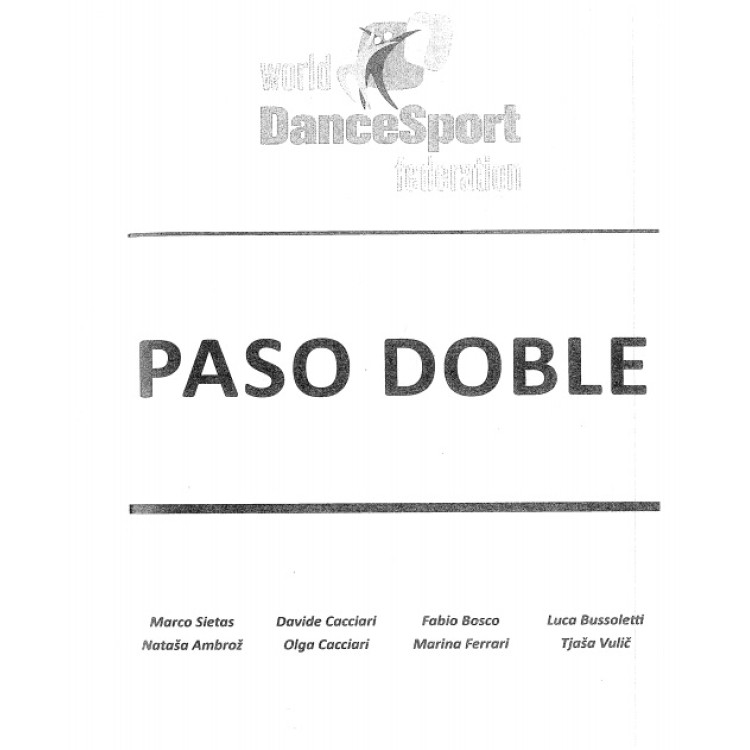
Paso Doble
Сумата се прибавя директно в кошницата
5.25 €
.
From the authors
Dear WDSF members,
It was a great honour for us to be asked by the WDSF to produce this work. As dancers and coaches we were aware from the outset that it would have been an unprecedented challenge to produce a series of books that could represent the WDSF Standard and Latin technique.
We approached the task seriously and with humility, trying at all times during our many hours of research to respect the values and canons that have been passed down to us through many generations of technical evolution, but producing at the same time a modern, up-to-date and fully developed guide for DanceSport competitors.
Seeing the final printed product was greatly gratifying and we hope that all those who study this material will be equally rewarded through a greater knowledge and that future generations of dancers will not only build a solid foundation based on these principles but develop further these concepts and dancesport in general.
We hope that our efforts and energy are received by the entire dancesport world with the same genuine sincerity that we put into this work, and that these manuals may give you the same satisfaction that they gave to us.
Good luck to everybody!
Best regards,
Davide and Olga Cacciari Fabio Bosco and Marina Ferrari Saverio Loria and Zeudi Zanetti Stefan Green and Adriana Sigona Sandro Cavallini Luca Bussoletti and Tjasa Vulic Zoran Plohl andTatsiana Lahvinovic
Since the recognition of the WDSF (then called IDSF) by the International Olympic Committee, DanceSport technique has developed and flourished with athletes bringing innovation to the floor at each and every competition.
Whereas the historic technique has always been a guideline for athletes and teachers, the aforementioned developments now require a new method of codification, respecting the fundamental principles of the past but including the dynamic changes of the present.
The new books use a similar chart system to that of the historic technique with the introduction of several new columns describing additional technical details.
This series includes a collection of ten books, five for Standard dances and five for Latin dances, and attempts to unify the language used in the two disciplines where possible.
Nine Levels of Difficulty
This book contains three levels of difficulty in terms of technical difficulty, and also the syllabus figures are divided into three different choreographic levels of difficulty.
The first technical level (Grey) contains six basic necessary fundamentals to allow a general understanding of the figure. The second technical level (Yellow) contains three updated principles of posture, position and action. The third technical level (Red) contains three advanced and completely new actions and principles.
The three choreographic levels of difficulty of the syllabus figures are Bronze, Silver and Gold.
These three choreographic levels and the three technical levels combine to create nine levels of difficulty designed to improve the process of study and preparation in DanceSport, involving everybody, from the Social dancer and teacher to the high level dancer, teacher and obviously judge.
.