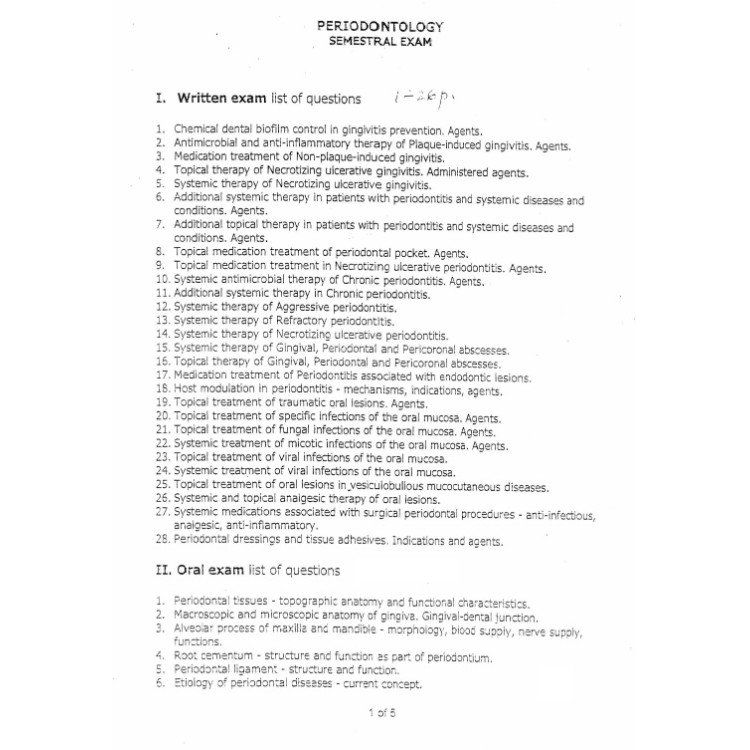
Periodontology semestral exam - notes
Сумата се прибавя директно в кошницата
11.66 €
The periodontal pocket
Over the years, a substantial amount of basic, preelm-leal and clinical research has provided us with significant knowledge on the diagnosis and treatment of periodontal disease. However, despite the increasing numbers of publications in this area, periodontists still face similar clinical challenges and questions as before. One of the main variables used to evaluate clinical success of periodontal therapy is periodontal pocket depth .reduction. Therefore, it is important to reflect on how the role of the periodontal pocket per so has helped guide the way in which we perform and interpret periodontal research. This reflection should include a critical appraisal of: (i) the precimical research methodologies; (ii) the experimental attempts to imitate the formation of periodontal pockets/periodontal disease; (iii) the structural and molecular changes taking place; (iv) the periodontal disease diagnostic procedures; and (v) the treatment modalities. As the primary goals of periodontal treatment are to arrest the inflammatory disease process and to establish a local environment that allows the maintenance of periodontal health, an in-depth understanding of the biologic processes that are associated with the clinical expression of the disease, as well as of the outcomes associated with its therapy, is essential.
Since the early 1980s, dental implants have been established as one of the preferred choices of treatment for partially or fully edentulous patients. However, in recent years, a significant increase in biologic complications around dental implants (i.e. peri-implant mucositis and peri-implantitis) has been reported in the literature. The fact that the diagnosis and treatment of peri-implant diseases is one of the major competencies that a specialist in periodontics receives as part of the curriculum of their postgraduate education (7) indicates the importance placed by the dental profession on this topic. It is also interesting to note that the etiopathogenesis, diagnosis, clinical manifestation and treatment modalities of peri-implantitis, exhibit, to some extent, similarities
to those of periodontitis. The clinical finding of the presence of a peri-implant pocket and its treatment by nonsurgical and surgical therapies for its treatment, are concepts directly 'borrowed' from those used for the resolution of the periodontal pocket.
In this volume of Period-ontology 2000, the topic of the 'periodontal pocket’ is divided into three entities. It starts, in the'first four papers, with the description of precimical models, anatomy and structural characteristics, then moves on to topics related to the role of gingival erevicular fluid, bacterial components and osteoimmunology in the next five papers, with the last four papers addressing common treatment modalities currently employed to treat periodontal pockets. In some of these articles, the presence of 'pathologic pockets’ around dental implants is also discussed, allowing the reader to identify similarities and differences between periodontal and peri-implant conditions. The aim of this introductory chapter is to familiarize the reader with the content of this volume of Periodontology 2000 by emphasizing the key points of the individual articles.
Precimical models: can we experimentally reproduce the periodontal pocket morphology?
Precimical research has been extensively used in the field of periodontology for evaluating the different nonsurgical and surgical treatment modalities. Throughout the decades, preclinical models have facilitated our understanding of periodontal wound healing and elucidated biologic principles, such as guided tissue regeneration, which is now used routinely for the treatment of various types of periodontal defects. Knowledge of the different types of preclinical experimental defect models that have been used in. the past, together with comprehension of the relevant ethical issues and experimental needs.