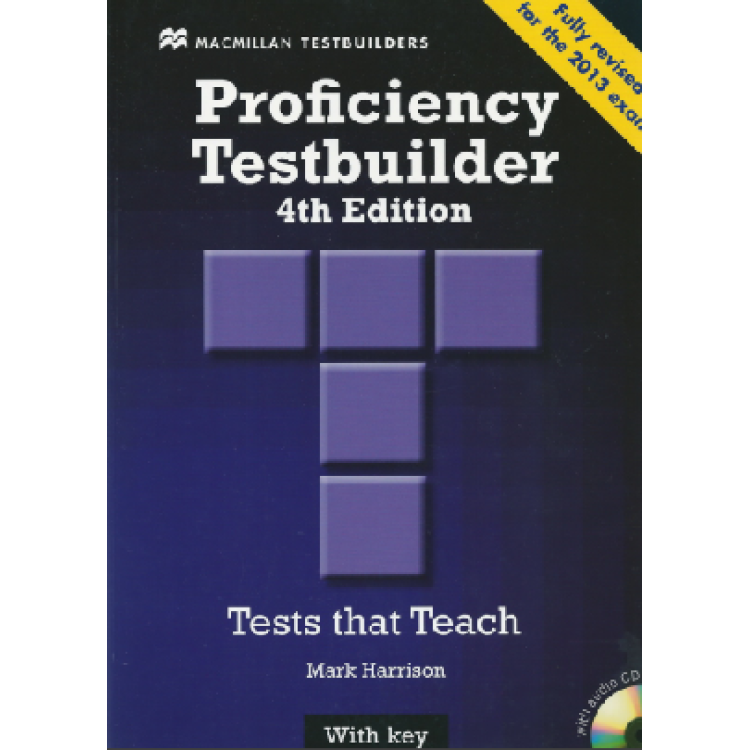
Proficiency Testbuilder 4th with Key
Сумата се прибавя директно в кошницата
8.16 €
Extract One
Malcolm Gladwell, in his book The Tipping Point, has produced a wonderfully off-beat study of that little-understood phenomenon, the social epidemic. His book is organised around the notion of the ‘tipping point’, the moment when, to put it bluntly, a thing takes off and becomes widespread in a particular society. For fax machines, it happened in 1987; for mobile phones, 1998. Ideas have their tipping points too. The point is that social epidemics usually take us by surprise.
Gladwell makes sense of them by anatomising them, showing how the spread of ideas or behaviour depends on types whom he christens ‘connectors' and ‘mavens’. Connectors jump-start the epidemic by virtue of the number of people they know - the book provides a test that allows the reader to work out whether they qualify. Mavens are specialists who possess the power of recommendation. Summarised like this, Gladwell’s dissection sounds a bit crude. In fact, The Tipping Point is a very subtle piece of work, coming out with ideas - not necessarily his own - that make conventional solutions to social problems seem criminally naive.
Extract Two
Why am I up here? 120 metres up the side of this crag, wearing a pair of close-fitting, technicolour climbing-trousers. Only another 25 metres to the top. Only? What am 1 trying to prove? Why is a man who feels dizzy near the edges of sea cliffs and sweats with fear at the top of towers, why exactly is he spending this warm afternoon, the day after his 46th birthday, dangling over a void attached to a long piece of purple-pink string? There is no answer to such fatuous metaphysical questions. Not when your climbing partner has just disappeared from view, for the first time, somewhere far above your head.
This is it, the proverbial moment. Out on my own.
Just me, my vertigo and a pair of borrowed rock boots, which are slightly too small, and a great wrinkled slab of ancient geology and a palpitating, sweat-soaked, miraculously heightened sense of existence. I wouldn’t be anywhere else. This is also the moment I realise, with a keen pang of guilt, that I completely forgot to check the small print in my life insurance where it states excluded risks. You know, the awesomely dangerous pursuits that men in their forties are so often drawn to, such as sponsored bungee-jumping and white-water rafting.
Extract Three
Interviewer: Writers rarely admit it, William, but they are in quite a comfortable position when they appear as speakers at events at literary festivals, aren’t they? They can read from their work, work already done, needing no more than a light dusting on the train to be in shape for the event. Questions asked on the back of such a sampling are gentle and entirely on the author’s terms.
Or they can branch out, talk about something which will have some interest because of the writer’s own proven involvement with that subject. Questions can be tougher here but writers are used to questions. They ask them of themselves every couple of sentences.
William: Yes, but the main thing is that it’s almost invariably a pleasure to meet readers. A writing life is solitary and mute, and often near to that of a depressive in its conditions. I cannot believe there is a writer who has not at times felt that his or her confidence has dropped open underneath like a trapdoor and suddenly there is nothing to build on and they are left dangling there. Meeting those whose equally solitary experience completes the act begun in hope of contact is a relief and an encouragement, as well as a pleasure.
TEST 1, PART 2
You will hear someone called Karen Williams talking about her career. For questions 7-15, complete the sentences with a word or short phrase.
Karen Williams: I left school with an ambition to work in hotels as a manager in England or maybe abroad.
My local college offered a two-year Diploma in Hotel Administration and Tourism. The course involved three periods of work experience as well as modules covering hotel front office, restaurant, housekeeping, business studies and languages.
My first work experience was in the housekeeping department of a hotel. It was hard work and I was only there for two weeks. I learnt all about cleaning rooms, what equipment to use, changing beds and, more importantly, about life in a hotel. For the last two days I worked with the floor housekeeper, planning rotas and checking rooms. The second placement was for four months. I went to work in Germany. Although I had studied the language at college, my language skills improved dramatically. Most of the time I worked in the restaurant and housekeeping. The final work experience of five weeks was in the front office of a hotel, where I learnt all about the switchboard, reservations, porter’s desk and cashiers.
I decided to carry on studying and do a Higher National Diploma, or HND, in Hospitality Management. During
the summer months between one course and another,
I worked in a restaurant kitchen. I had never worked in a kitchen before and it was interesting to see how one worked. Although I decided that I didn’t want to be a chef, the experience of seeing what goes on was invaluable.
The two-year HND was very interesting. Some students had come straight from school, some from hotel and catering courses and some had got into the course as a result of their age and experience. We studied a range of subjects, including business studies, hotel management, human resource management and operational techniques. There were also some optional subjects and I took conference and leisure facility management, advanced business and languages. The work experience was very useful, and I had to write a detailed report on ‘green issues’ in hotels. That was probably the thing 1 found most difficult on the course, although it certainly gave me a different perspective on things. It was interesting - for example, I reviewed give-aways such as soaps and shampoos as part of the report. I became a student member of the HCIMA, the Hotel and Catering International Management Association, when I started the course and I was able to request information from them. Their magazines often have articles of interest that students can use for assignments. My other source of information was Caterer and Hotelkeeper, the weekly magazine.
The college was associated with a university, and so after 1 completed the HND, I was able to go straight onto the third year of a degree in Hotel and Restaurant Management. I completed that course fairly recently and I’ve just started work as a junior assistant manager at a London hotel. I love the work there, although sometimes the duty management shifts are a bit of a killer. Usually the hotel is overbooked when I am on duty and so I often end up as the one who has to book out guests. We use a nearby hotel of the same standard and provide transport but it is understandable when a guest gets very irate, arriving after a long journey. My aim is to stay here to gain experience before I move on. Possibilities include hotels within the group or maybe abroad, where I can use my languages. One day I’d like to be a General Manager.
TEST 1,PART 3
You will hear an interview with someone who consulted a ‘life coach’ to improve her life. For questions 16-20, choose the answer (A, B, CorD) which fits best according to what you hear.
Interviewer: My next guest is Brigid McConville, a journalist who decided to get herself a ‘life coach'.
Brigid, what made you do it and what is a ‘life coach’?
Brigid: Well, all was not entirely well with my life. Nothing drastic: I just felt ‘stuck’ and in need of change, 144
both on the work front - too much to do, too little time - and at home - ditto. I wasn’t miserable enough for therapy or counselling. I simply wanted to get a little more from life. Until recently, the options for someone in my situation would have been extremely limited. Now, however, legions of 'life coaches’ are out there, ready and waiting to come to the aid of the frustrated and down-at-heart. For about £40 a session, your personal coach will telephone you once a week, and spend half an hour talking to you in an effort to help you sort your life out.
Interviewer: But isn’t this just another self-improvement fad? Like all the self-help books and tapes?
Brigid: Well, I was a bit dubious myself, but I decided to try it. I booked a course with Fiona Harrold, a leading British coach. She identified my anxieties almost immediately. Within half an hour of our first conversation, I found myself agreeing that the first thing I had to tackle was my deeply ambivalent relationship with money. Yes, of course it was rooted in childhood - but what could we actually do about it? Fiona is a passionate advocate of self-belief and, with her characteristic verve, she told me I had to carve out a whole new way of thinking about myself. I must see myself as ‘a magnet for money’, she said. And she told me: ‘Consider yourself someone to whom cash flows effortlessly. Why shouldn’t you have an easy life, an abundance of pleasure, leisure and luxury - and all without feeling any guilt?’
Interviewer: How did you react to that?
Brigid: Well, it seemed such a preposterous idea that I laughed out loud down the telephone. But, undeterred by my scepticism, Fiona told me to suspend my disbelief, and gave me a clutch of positive affirmations with which to brainwash myself into readiness for riches. She told me to repeat the following words whenever possible: ‘I, Brigid, am now ready to have the ideal life that I deserve.’ Doing this, I found, cheered me up no end.
Interviewer: What else did she tell you?
Brigid: Well, subsequent sessions were more practical. First came the mandatory de-cluttering - she told me to throw out as much unnecessary jumble and rubbish as possible, clearing space for all the goodies to come -once the money started to roll in. Then we began trying to cure my personal finance phobia; I dutifully did my sums, and started saving something, however small, every month. My work also came under close scrutiny, too, as I made up my mind to concentrate on jobs that really interested me. Exactly which issues you tackle during coaching is up to you. According to Fiona, most people want to get organised at home and at work, make the most of their abilities and sort out money problems. She reckons that building up confidence is vital.