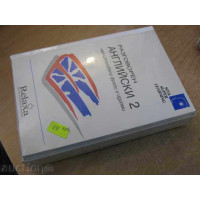
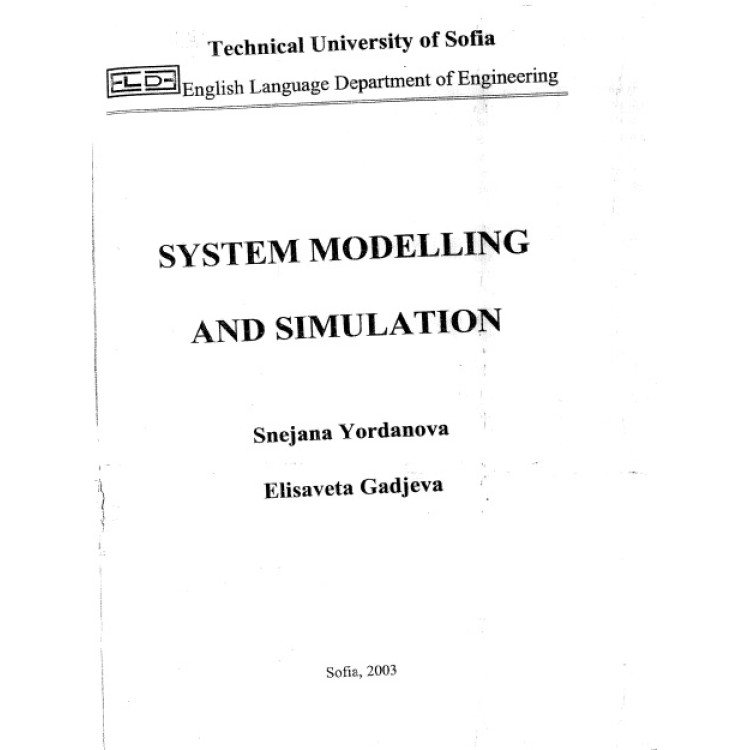
System modelling and simulation Yordanova Technical University 2003г.
Сумата се прибавя директно в кошницата
3.50 €
CONTENTS
Page
I. INTRODUCTION TO SYSTEM MODELLING 3
1.1. A notion of a system 3
1.2. System representation 4
1.3. Modelling of some processes 9
1.4. Exercises 16
1.5. Questions and problems 19
II. MODEL TRANSFORMATIONS 21
2.1. Linearisation 21
2.2. Mathematical model reduction 23
2.3. Discretization of models of parameter distributed systems 28
2.4. Mathematical model construction for complex systems and model 31
parameter estimation
2.5. Exercises 35
2.6. Questions and problems 38
Ш. COMPUTER SIMULATION 40
3.1. Methodology of simulation 40
3.2. Numerical integration methods for the solution of differential equations 42
3.3. Numerical integration methods for linear systems 50
3.4. Numerical integration methods for models with partial derivatives 51
3.5. Special classes of numerical integration methods and recommendations 53 for the selection of the method
3.6. Accuracy and stability of the solution of numerical integration methods 53
3.7. Exercises 57
3.8. Questions and problems 59
. IV. SIMULATION LANGUAGES, SYSTEMS AND SOFTWARE 61
4.1. Simulation languages 61
4.2. Programme systems for simulation 63
4.3. MATLAB environment - a programme system for simulation 64
4.4. MATLAB aplication SIMULINK ' 70
4.5. Simulation of production, discrete event and queuing systems 80
4.6. Simulation with GPSS 85
4.7. Exercises 87
4.8. Questions and problems 92
V. COMPUTER MODELLING AND SIMULATION SYSTEMS ^ 95
EXAMPLES, LABORATORY AND COURSE ASSIGNMENTS
5.1. Modelling and simulation of the temperature in a furnace 95
5.2. Modelling of a batch process in a chemical reactor 97
5.3. Modelling of a hydraulic system 98
5.4. A multi-tank flow system 100
5.5. A bouncing ball 101
5.6. A demand-production-inventory economic plant model 102
5.7. A dynamic population problem 105
5.8. A population competition problem 106
5.9. Heating of a solid body with distributed parameters 107
VI. STRUCTURE AND COMPOSITION OF GENERAL-PURPOSE 109 SIMULATION PROGRAMS
6.1. The structure of the OrCAD system with graphical editors Capture and 109 Schematics
6.2. Types of analyses 110
6.3. The library file set 111
6.4. The circuit file set 112
VII. COMPUTER MODELLING AND SIMULATION OF LARGE 113
CIRCUITS AND SYSTEMS
7.1. Sparse matrix approach 113
7.2. Modified nodal analysis 119
VIII. ALGORITHMS FOR COMPUTER SIMULATION 122
OF NONLINEAR AND LINEAR CIRCUITS
8.1. Nonlinear Direct: Current (DC) Analysis 122
8.2. Analyses in the frequency domain 126
8.3. Analysis in the time domain 132
8.4. Fourier analysis 137
IX. SIMULATION PRACTICE USING ORCAD PSPICE 139
9.1. Create the project 139
9.2. Draw the circuit 139
9.3. Set the simulation profile 140
9.4. Analyze the circuit and display the results ‘ 141
REFERENCE 142