Теми чуждестранни Hygiene VI course
Сумата се прибавя директно в кошницата
12.24 €
Етикети: Теми чуждестранни Hygiene VI course
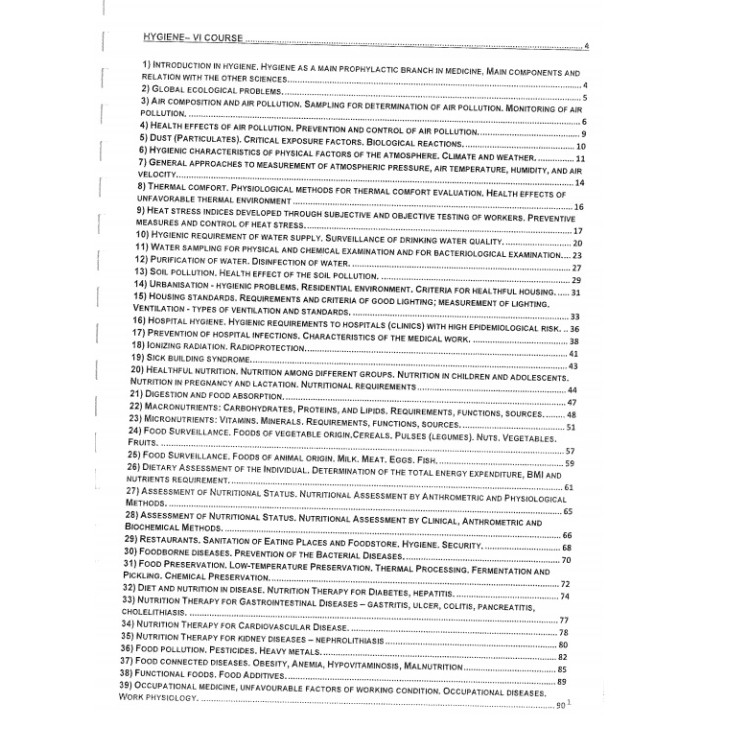
1} Introduction in hygiene. Hygiene as a main prophylactic branch in medicine, Main components and
RELATION WITH THE OTHER SCIENCES 4
2) Global ecological problems. 5
3) Air composition and air pollution. Sampling for determination of air pollution. Monitoring of air
pollution 6
4) Health effects of air pollution. Prevention and control of air pollution. 9
5} Dust (Particulates). Critical exposure factors. Biological reactions ю
6) Hygienic characteristics of physical factors of the atmosphere. Climate and weather li
7) General approaches to measurement of atmospheric pressure, air temperature, humidity, and air
VELOCITY... 14
8) Thermal comfort. Physiological methods for thermal comfort evaluation. Health effects of
unfavorable thermal environment 16
9) Heat stress indices developed through subjective and objective testing of workers. Preventive
measures and control of heat stress..... 17
10} Hygienic requirement of water supply. Surveillance of drinking water quality 20
11) Water sampling for physical and chemical examination and for bacteriological examination.... 23 12} Purification of water. Disinfection of water. 27
13) Soil pollution. Health effect of the soil pollution 29
14) Urbanisation - hygienic problems. Residential environment. Criteria for healthful housing 31
15) Housing standards. Requirements and criteria of good lighting; measurement of lighting.
Ventilation ~ types of ventilation and standards 33
16) Hospital hygiene. Hygienic requirements to hospitals (clinics) with high epidemiological risk. 36
17) Prevention of hospital infections. Characteristics of the medical work. 38
18) Ionizing radiation. Radioprotection 41
19} Sick building syndrome 43
20) Healthful nutrition. Nutrition among different groups. Nutrition in children and adolescents.
Nutrition in pregnancy and lactation. Nutritional requirements 44
21) Digestion and food absorption. 47
22) Macronutrients: Carbohydrates, Proteins, and Lipids. Requirements, functions, sources......... 48
23) Micronutrients: Vitamins. Minerals. Requirements, functions, sources. 51
24) Food Surveillance. Foods of vegetable origin.Cereals. Pulses (legumes). Nuts. Vegetables.
Fruits 57
25) Food Surveillance. Foods of animal origin. Milk. Meat. Eggs. Fish 59
26) Dietary Assessment of the Individual. Determination of the total energy expenditure, BMI and
nutrients requirement 61
27} Assessment of Nutritional Status. Nutritional Assessment by Anthrometric and Physiological Methods 65
28) Assessment of Nutritional Status. Nutritional Assessment by Clinical, Anthrometric and
Biochemical Methods 66
29) Restaurants. Sanitation of Eating Places and Foodstore. Hygiene. Security. 68
30) Foodborne diseases. Prevention of the Bacterial Diseases 70
31) Food Preservation. Low-temperature Preservation. Thermal Processing. Fermentation and
Pickling. Chemical Preservation. 72
32) Diet and nutrition in disease. Nutrition Therapy for Diabetes, hepatitis. 74
33} Nutrition Therapy for Gastrointestinal Diseases - gastritis, ulcer, colitis, pancreatitis, cholelithiasis. 77
34) Nutrition Тherapy for Cardiovascular Disease. 78
35) Nutrition Therapy for kidney diseases - nephrolithiasis so
36} Food pollution. Pesticides. Heavy metals 82
37) Food connected diseases. Obesity, Anemia, Hypovitaminosis, Malnutrition 85
38) Functional foods. Food Additives 89
39) Occupational medicine, unfavourable factors of working condition. Occupational diseases.
Work physiology. .....so1