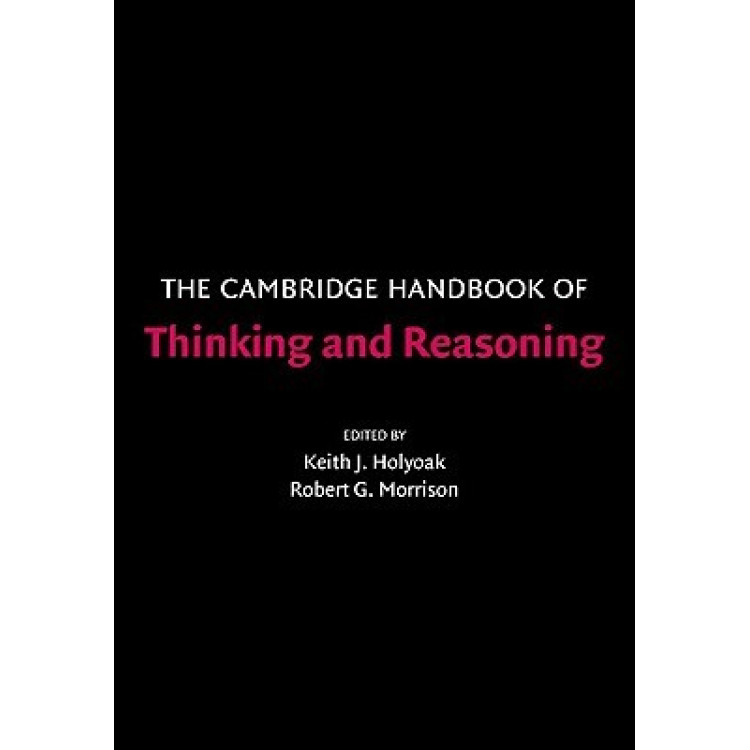
The Cambridge Handbook of Thinking and Reasoning
Сумата се прибавя директно в кошницата
13.99 €
Preface
A few decades ago, when the science of cognition was in its infancy, the early textbooks on cognition began with perception and attention and ended with memory. So-called higher-level cognition - the mysterious, complicated realm of thinking and reasoning - was simply left out. Things have changed - any good cognitive text (and there are many) devotes several chapters to topics such as categorization, inductive and deductive reasoning, judgment and decision making, and problem solving. What has still been missing, however, is a true handbook for the field of thinking and reasoning - a book meant to be kept close “at hand” by those involved in the field. Such a book would bring together top researchers to write chapters, each of which summarizes the basic concepts and findings for a major topic, sketches its history, and provides a sense of the directions in which research is currently heading. This handbook would provide quick overviews for experts in each topic area, and more importantly for experts in allied topic areas (became few researchers can keep up with the scientific literature over the full breadth of the field of thinking and rea-
soning). Even more crucially, this handbook would provide an entry point into the field for the next generation of researchers by providing a text for use in classes on thinking and reasoning designed for graduate students and upper-level undergraduates.
The 'Cambridge Handbook of Thinking and Reasoning is intended to be this previously missing handbook. The project was first conceived at the. meeting of the Cognitive Science Society in Edinburgh, Scotland, during the summer of 2001. The contents of the volume are sketched in Chapter 1. Our aim is to provide comprehensive and authoritative reviews of all the core topics of the field of thinking and reasoning, with many pointers for further reading. Undoubtedly, there are still omissions, but we have included as much as we could realistically fit in a single-.volume. Our focus is on research from cognitive psychology, cognitive science, and cognitive neuroscience, but we also include work related to developmental, social, and . clinical psychology; philosophy; economics; artificial intelligence; linguistics; education; law; and medicine. We hope that scholars and students in all these fields and others will find this to be a valuable collection.
We have many to thank for their help in bringing this endeavor to fruition. Philip Laughlin, our editor at Cambridge University Press, gave us exactly the balance of encouragement and patience we needed. It is fitting that a handbook of thinking and reasoning should bear the imprint and indeed the name of this illustrious press, with its long history reaching back to the origins of scientific inquiry. Michie Shaw, Senior Project Manager at TechBooks, provided us with close support throughout the arduous editing process. At UCLA, Christine Vu did a great deal of organizational work in her role as our editorial assistant for the entire project. During this period, our own efforts were supported by grants R305H03014] from the Institute of Education Sciences and SES-0080375 from the National Science Foundation to KJH, and from Xunesis and National Service Research Award MH-064244 from the National Institute of Mental Health to RGM.
Then there are the authors: (It would seem a bit presumptuous to call them “our” authors'!) People working on tough intellec-
tual problems sometimes experience a moment of insight - a sense that although many laborious steps may lay ahead, the basic elements of a solution are already in place. Such fortunate people work on happily, confident that ultimate success is assured. In preparing this handbook, we also had our moment of "insight.” It came when all these outstanding researchers agreed to join our project. Before the first chapter was drafted, we knew the volume was going to be of the highest quality. Along the way, our distinguished authors graciously served as each other’s critics as we passed drafts around, working to make the chapters as integrated as possible, adding in pointers from one to another. Then the authors all changed hats again and went back to work revising their own chapters in light of the feedback their peers had provided. We thank you all for making our own small labors a great pleasure.
KEITH J. HOLYOAK-University of California, Los Angeles
ROBERT G. MORRISON' Xunesis, Chicago October 2004: