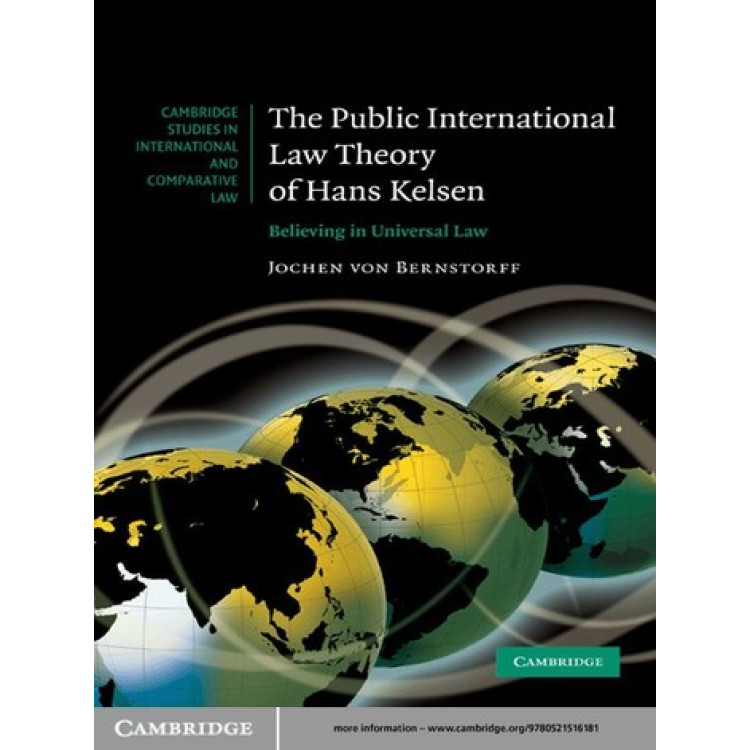
The Public International Law Theory of Hans Kelsen
Сумата се прибавя директно в кошницата
12.24 €
.
CONTENTS
Preface page xiii Introduction 1
part I The quest for objectivity: the method and construction of universal law 13
1 Method and construction of international law in nineteenth-century German scholarship 15
A Kaltenborn and the “objective principle” of international law 15
I The “subjective principle” in Kant and Hegel 17 II Humanity as a “community of law” [Rechtsgemeinwesen] in Kaltenborn 18
B Bergbohm and Fricker: “The problem of international law revisited” 21
C Jellinek as synthesis 26
I The free will of the state as the formal ground of all law 28 II The concept of “self-obligation” [Selbstverpflichtung] and the obligatory nature of public law 30
III The theory of the guaranteed norm 32
IV Jellinek’s “objective international law” 32
1 The “nature of the thing” [Natur der Sache] as a principle
of objectification 32
2 “Shared interests” and “purpose of the state” as the final sociological foundation of objective international law 35
D Heinrich Triepel and the “common will” [Gemeinwille] as a principle of objectivization 38
Conclusion 42
2 Kelsenian formalism as critical methodology in international law 44
A A new methodological tool kit 44
I Methodological dualism as the starting point 45 II Methodological critique through the “identity thesis” 50
III The anti-ideological thrust of the new methodology 54
B The function of the critical methodology: law as a universal medium for shaping society 56
I Volk, nation, and state in international law 56
II Law as a universal medium of societal change 60
C The fundamental critique of the conceptual apparatus of international law 61
I The conceptual uncoupling of the notion of sovereignty
from the “state as a legal person of will” [willensfahige Staatsperson] 61
1 Critique of the conception of sovereignty as a core stock of state competencies 63
2 Sovereignty as a hierarchy-creating, ordering element of the legal system 64
II The critique of the doctrine of self-obligation 67
III The critique of a dualism of state law and international law 70
1 A crititue of the duality of sources 70
2 A critique of the duality of regulatory objects 71
D The opponents of the critical method: Kelsen’s abstract conceptual world as a “radical-logicistic metaphysics” 73
3 An “objective” architecture of international law: Kelsen, Kunz, and Verdross 78
A Constructing a unitary system 78 I Systemic unity as an epistemological postulate 79
II “Delegation” as a unity-creating structural
principle 80
III The idea of unity in the discourse on international law 82
B International law as law endowed with the power of coercion 84
I Central compulsion and the “world state trap”
[Weltstaatsfalle] 84
II Reprisals and war as decentralized means of coercion 87 III The coercive character as an evolutionary achievement 90
C The primacy thesis: the construction of an international law above the state 93 I The delimitation of the state’s spheres of competence through international law 93
II The primacy thesis and the problem of norm conflicts 96
III The defense and further development of the primacy thesis 97
IV The primacy thesis, domestic jurisdiction, and the decisions
of the Permanent Court of International Justice (PCIJ) 100
D The quarrel over the choice hypothesis [Wahlhypothese] 104
E The opponents of the construction of a universal law and the notion of the “world state” 108
I Universal law, the “world state,” and the civitas maxima 108
II The universal system of law as natural law? 112 III The abuse of the idea of universalism 116
part II The outlines of the cosmopolitan project - the
actors, sources, and courts of universal law 119
4 The new actors of universal law 123
A Legally organized communities above the state 125
I Unions of states as a dynamic continuum of legal integration 126
1 Unions of states as a particular international legal community 127
2 The doctrine of centralization and decentralization 130
3 Sovereignty as the state’s direct subordination to
international law [Volkerrechtsunmittelbarkeit] 132
II The legal nature of the League of Nations 133
1 The League of Nations as a personified sub-order of international law 136
2 The League of Nations as a community of joint ownership
[Gemeinschaft zur gesamten Hand] 140
III The opponents of an “integration-friendly” theory of international law 143
B The individual 146
I Positive law 146
II The critique of Scelle and Politis 148
C Universal law as a dynamic system of integration 150
5 Legal sources as universal instruments of law-creation 153
A Sources beyond metaphysics and consensus 153 I The critique of metaphysical dualism 154
II The critique of the positivist consensus model 157
III The hypothetical character of international law: the basic norm of international law 160
B The legal sources of international law and the hierarchical structure of the law 165
I Customary law 167
1 Dispensing with the opinio iuris 168
2 The replacement for the opinio iuris 170
II An objective doctrine of treaties 172
1 The creation of the treaty-based legal order 173
2 The international treaty’s mode of action 176
C The theory of legal sources as a self-limitation of legal scholarship 179
D The opponents of a “dematerialized” doctrine of legal sources 181
I Rematerialization as a strategy of revision 181
II Pure Theory of Law and the “unjust” status quo 185
III Replacing the ideal of justice with the ideal of peace 188
6 The international judiciary as the functional center of universal law 191
A Peace through compulsory jurisdiction 191
I The politico-legal approach: the Permament League for the Maintenance of Peace 193
II The socio-historical approach: compulsory jurisdiction as a necessary step toward a centralized, universal legal system 198
III The doctrinal approach: the fundamental critique of the doctrinal limitation on the judicial function in international relations 203
B The theoretical classification of the judicial decision 212
I The function of the judicial decision within the hierarchical structure of the law 212
II The nature of judicial decision-making 214 III The postulate of compulsory jurisdiction as the consequence of a system-oriented conception of the law 218
C Realist opposition to the quest for a strong international judiciary: compulsory jurisdiction as another “distinguished international lawyer’s dream” 220
7 The role of the international legal scholar after Kelsen - a concluding reflection 225
Postscript - on Kelsenian formalism in international law (2010) 233
Career sketches: Hans Kelsen, Alfred Verdross, and Josef Laurenz Kunz 272
Bibliography 286 Index 316