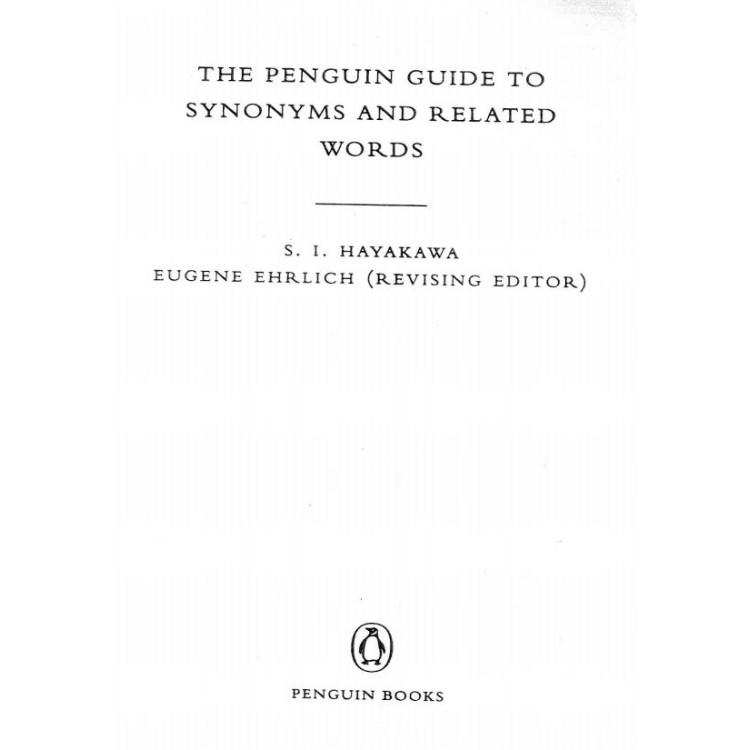
The penguin guide to synonyms and related words
Сумата се прибавя директно в кошницата
8.74 €
.
Introduction
by S.I. Hayakawa
English has the largest vocabulary and the greatest number of synonyms of any language in the world. This richness is due to the fact that the English language has grown over the centuries by constantly incorporating words from other languages. Even before the Norman Conquest, the Anglo-Saxon vocabulary included words borrowed from Latin (street, mile, the combining form Chester in the names of towns); Greek (priest, bishop)·, Celtic (crag, bin)·, and Scandinavian (law, fellow, egg, thrall). After the Norman Conquest, the English vocabulary was virtually doubled by the addition of French words, especially those reflecting a higher standard of living and a more complex social life: for example, words connected with food (sugar, vinegar, boil, fry, roast); clothing (garment, robe, mantle, gown); law (plaintiffperjury, legacy); religion (convent, hermitage, chaplain, cardinal); and social rank and organization (prince, duke, count, vassal, mayor, constable).
While much of the new French vocabulary described new ideas and activities, a great deal of it duplicated existing Anglo-Saxon vocabulary, giving the writer or speaker a choice of synonyms: cure (French) or heal (Anglo-Saxon), table or board, poignant or sharp, labour or work, mirror or glass, assemble or meet, power or might. Sometimes, the duplication of vocabulary was used to make distinctions: ox, swine, calf and deer were called — when killed and prepared for cooking — beef, pork, veal, and venison; hitting, striking, stealing, and robbing became, when viewed through the eyes of French law, assault, battery, larceny, and burglary.
With the enormous expansion of classical learning in the Renaissance, there was a great influx of words of Latin and Greek origin into the language, dictated by the demands of an enriched intellectual and cultural life. Also, the larger world discovered through travel (from the Crusades onwards) and exploration (especially in the Elizabethan period) provided a great stimulus to culture and language. There also arose in the sixteenth century a fashion for ornamenting one’s discourse with what were then called aureate or inkhom terms drawn from Greek and Latin. Shakespeare’s ‘multitudinous seas incarnadine’ is a well-known example, and what happened to these particular words is typical of the fate of this new vocabulary: multitudinous stayed in the language as one of several synonyms for many, while incarnadine is not heard any more except in this context. In brief, many words of classical origin introduced into the language during the Renaissance became permanent additions, but most were soon forgotten or were relegated to special technical contexts, like hebdomodary (weekly) and gressorial (having to do with walking).